
IWPR and the INIDI Public Foundation have completed the “Civil Society for Kazakhstan” project with the final conference event, funded by the European Union, and have taken stock of three years of work.
On 24-25 September 2026, the CS4K project’s final conference, “Time to Preserve Meaning,” took place in Almaty. Participants discussed the project’s results and talked about how civil society in Kazakhstan can develop amid today’s challenges.
The conference was more than a closing event. It was a space for open dialogue about restoring meaning to civic work, mutual support, solidarity, and finding joint solutions. Representatives of government bodies, civil society organizations, international partners, donors, experts, the media, and activists took part. The central message of the meeting was that even as civic space narrows, real change is possible through professionalism, partnership, solidarity, and dialogue.
Day 1: Stories of change and discussions
The first day, 24 September, opened with a discussion of the context in which civil society operates today. Participants then heard “stories of change”: ten local advocacy initiatives supported under the project were presented in two blocks of five. A general discussion of all ten initiatives followed.
Key results of the initiatives presented:
- Diabetic Parents’ Committee: insulin pumps for adults. The team drew on data from 465 patients, the opinions of 20 doctors, and a review of 21 international studies. Order No. 57 was signed on 25 May 2026 and will take effect on 1 January 2027.
- Wings of Liberty PF: personal data protection for NGOs. The first systematic study covered 111 organizations in 17 regions. It found that only 39.6% of organizations have an internal data protection policy, and only 27.9% have appointed a responsible person. Recommendations were prepared in two languages, and a dialogue with the relevant ministry has begun.
- Just Support PF: protecting children from bullying and violence. The organization’s proposals are reflected in the national plan “Children of Kazakhstan” for 2026-2030, and in June 2026 Just Support joined the ministry’s permanent NGO expert group.
- Support for the Initiatives PF: rural women’s access to healthcare. The study covered 582 respondents and 27 interviews. Of 24 recommendations, 10 have been implemented or are in progress: a rural outpatient clinic was renovated, specialists’ schedules were expanded, and video monitoring was introduced to prevent fictitious appointment records.
- Civil Alliance of Pavlodar Region: pasture management. Following a study of 531 households and 11 recommendations, a plan was published and a coordination and oversight body was designated.
- Meyirim Public Association: workplace harassment. 155 respondents took part in the survey, 64% of whom reported perceiving harassment in the workplace, and 44 stories were collected. The Ministry of Labor reported that the term “sexual harassment” has been included in the draft amendments to the Labor Code.
- My Home Public Association: reintegration of women after release. Based on a study involving one hundred women, a model for a non-governmental “one-stop-shop” service was developed. 22 women received comprehensive assistance, and 18 of them were provided with temporary housing.
- Korgan-M Republican Public Association: inclusive emergency preparedness. A survey of more than 430 people showed that over 70% had difficulties during evacuation and 34% would be unable to evacuate on their own. The national Ministry of Emergency Situations circulated the report to its units, and local measures and a request for training followed.
- Daris-2016 Public Association: education of migrant children. Based on more than twenty resolved cases, 25 recommendations were prepared. Government Resolution No. 56 of 29 January 2026 added a separate section on migrant children to the “Children of Kazakhstan” Concept.
- Mama Pro PF : psychological support for parents of children with disabilities. 1,119 people took part in the survey: 73% live with constant anxiety, and only 5.7% had used state-provided psychological help. Responses were received from three ministries, and a pilot for ten mothers will launch in autumn 2026.
The strongest cases share a common approach: the problem is framed through the concrete experience of a person or community, backed by data, and translated into a specific regulatory, budgetary, or administrative mechanism. Beneficiaries, specialists, and the bodies responsible for implementation were involved, and the result was secured through a document, a designated responsibility, or a working service.
Materials and details on each of the ten supported projects are available via the link.
In the second half of the day, participants worked in a World Café format. Tables discussed:
- human rights in everyday life and how to bring change closer to people;
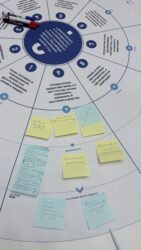
- the narrowing civic space and ways to preserve freedom of action and NGO resilience;
- local advocacy and what actually works in the regions;
- the safety and support of activists, so they are not left to face risks alone;
- trust in NGOs and talking to society in plain language;
- financial sustainability and moving beyond grant dependence;
- state-NGO partnership: where it is possible and where it turns into imitation;
- business-NGO partnership;
- the image of civil society in 3-5 years: what to preserve, change, and build together.
The evening included an expert lounge in a live podcast format, the close of the first day, and then a group dinner and networking.
Speakers
Speakers at the conference included Ruslan Zakiev (Director, Diabetic Parents’ Committee DiaRKom Public Foundation), Svetlana Bogatyreva (Executive Director, Just Support private foundation), Irina Zhdanova (Chair, “My Home” Center for Development and Social Assistance to the Population), Sergey Gulyaev (Director, Desenta Foundation), Madina Tulepova (Chair, Support of Initiatives Public Association), Denis Dzhivaga (Director, Kazakhstan International Bureau for Human Rights and Rule of Law), Irina Mednikova (General Director, Youth Information Service of Kazakhstan), Aizhan Alzhanova (President, Mama Pro Foundation), Gulmira Birzhanova (Head of the Legal Service, “Media Qoldau,” Legal Media Center), and Svetlana Mogilyuk (Chair, Civil Alliance of Pavlodar Region Association).
Day 2: Results and recognition
 The second day, 25 September, began with a presentation and discussion of the World Café results. A ceremony recognizing the contributions of project participants followed. The conference concluded with closing remarks and a group lunch.
The conference combined three levels of analysis: specific stories of change, a collective diagnosis of the state of civil society, and expert reflection on values and sustainability. This structure made it possible to move from “what worked” to “why it worked,” and then to the question of “what infrastructure is needed for results to be repeatable.”
Participants themselves gave the event high marks:
“The conference was held at the highest level, creative and interactive.”
— conference participant“I really enjoyed taking part in this event and got answers to many of my questions. I would very much like such events to be held regularly.”
— conference participantThis publication is funded by the European Union. Its contents are the sole responsibility of IWPR and does not necessarily reflect the views of the European Union.